
HOMEMADE, Performed
Part 1: The semiotics of Nara Smith’s cookbook cover

By Stefania Gogna
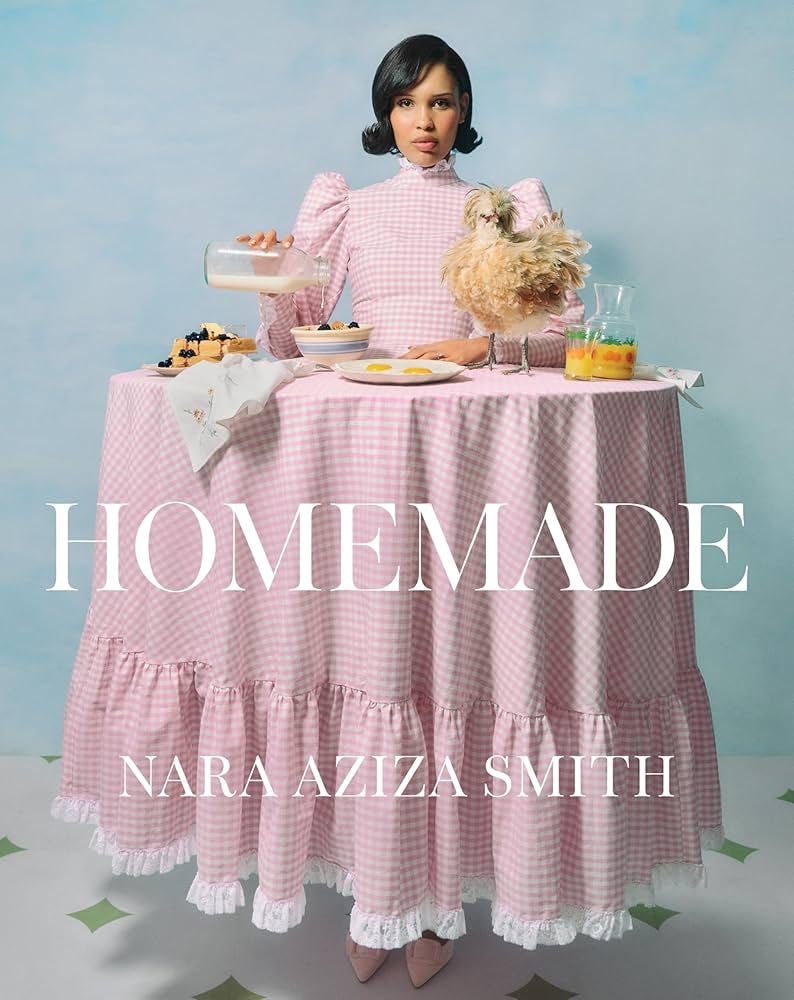
Barbie meets the tradwife aesthetic, but with a gaze that asks for no permission and performs no submission. It sounds like a joke, but it is the semiotic heart of this cover.
At first glance, the cover of HOMEMADE presents a simple and immediately recognizable domestic scene, already transposed into an artificial, polished universe, almost like a Barbie house.
The signs are familiar: the set table, the milk, breakfast, the dominant pink of the fabric—all elements constructing the feminine imaginary of “homemade.” Yet the register is deliberately hyper-stylized, closer to a set than to a truly lived-in home.
The domestic universe is not only around the woman. Home, care, nourishment, and “homemade” are not only practices traditionally associated with femininity, but become part of how femininity itself is culturally defined. The domestic sphere does not remain an external setting; it is written onto the female body.
There is no separation between the woman’s body and the space of the table. This overlap dissolves the boundary between subject and environment. She is not simply sitting at the table, serving it, or preparing breakfast. The woman is the table.
She becomes the infrastructure of the domestic, the surface on which nourishment takes shape. It makes visible, with almost brutal elegance, a deeply rooted cultural archetype: the woman as nourishing mother, the woman as living home, the figure on which the entire domestic order symbolically rests.
And yet this fusion is not natural. It is hyper-constructed.
Everything suggests control, artifice, staging: the gingham pattern, the pink palette, the perfect symmetry, the suspended gesture of pouring milk. It is this perfection that makes the image too constructed to be read as natural. We are not looking at a lived-in home, but at a home curated like a set. Here, “homemade” is not authenticity; it is aesthetics.
Within this space, the female figure activates a second tension.
The dress recalls retro codes of the 1950s, linked to a traditional idea of domestic femininity as guarantor of harmony, nourishment, and order. Yet Nara Aziza’s gaze breaks this frame completely. She is not welcoming, sweet, or subordinate. Her expression is direct, almost cold, fully aware.
We are not looking at a woman who is that role, but at a woman performing it. And in this way, domesticity becomes performance.
Food also participates in this logic. Milk, eggs, berries, cereals, juices: universal signs of domestic breakfast, of purity and simplicity. But they are arranged as objects to be looked at, not consumed. Everything is intact, still, suspended.
Food loses its primary function and becomes sign. It does not nourish; it signifies.
Then there is the ornamental hen—a Silkie, most likely— that introduces an uncanny note. It is not the functional chicken of the farmyard or kitchen, but an almost decorative, fluffy, theatrical presence, closer to a prop than to a domestic animal.
The title, HOMEMADE, works almost ironically. The more it promises authenticity, the more the image reveals artifice. The more it evokes the natural, the more everything appears orchestrated.
This is not a return to domesticity. It is its contemporary staging. “Homemade” is no longer a daily practice, but an aesthetic performance of authenticity.
Meet the Contributor

Stefania is an independent semiotician working at the intersection of cultural analysis and consumer insight. Based in Milan, she collaborates with international brands to explore emerging cultural dynamics and uncover the meanings shaping people’s relationships with products, communication, and everyday consumption.
I was convinced that it was a crinoline pretending to be a table, not a table behind which the model was hiding.